
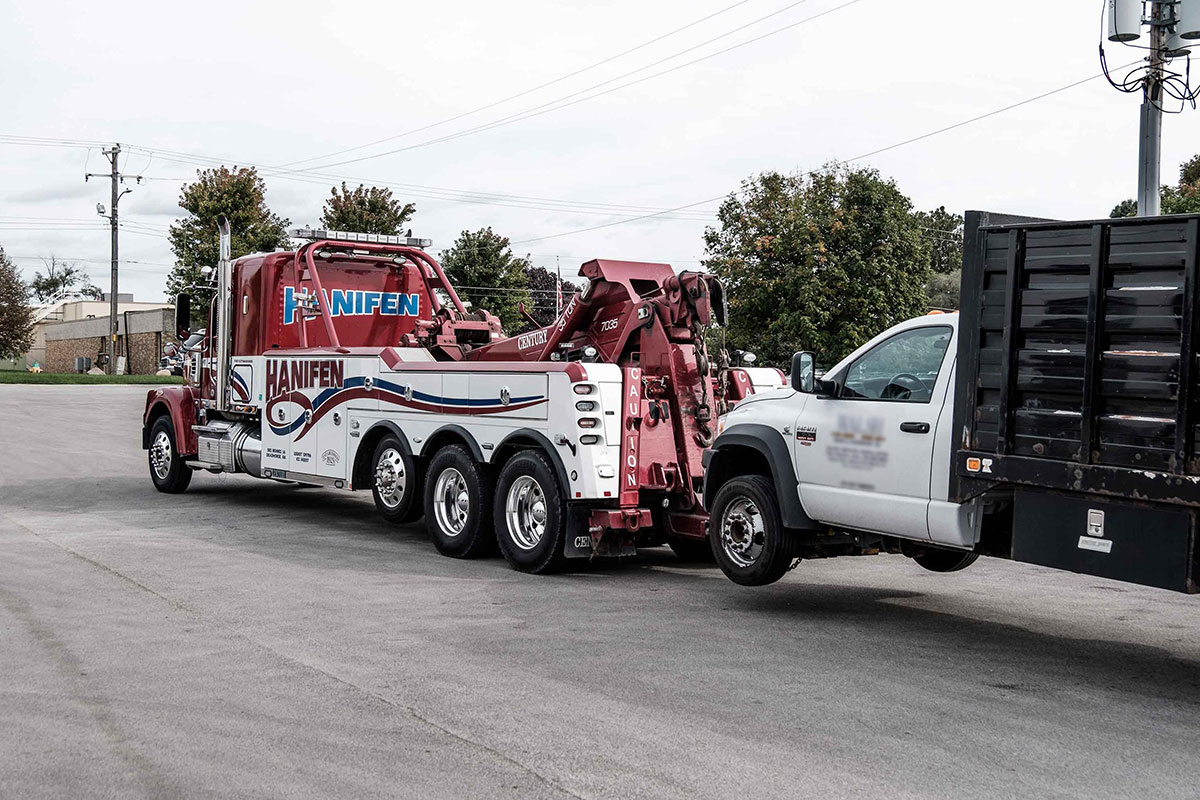
Heavy duty towing covers the vehicles a standard wrecker cannot touch: semi tractors and trailers, straight trucks, dump trucks, buses, motorhomes, and construction and farm equipment, generally anything over 26,000 pounds GVWR. The work takes purpose-built trucks and trained operators. A heavy wrecker with under-reach tows a disabled tractor on its own wheels. A rollover or an off-road recovery usually calls for a rotator. Equipment that cannot roll at highway speed goes on a Landoll trailer.
This guide walks through how to tell which truck your situation needs, what your driver should do while help is on the way, what a stranded truck really costs, and how to vet a heavy duty provider before you ever need one. Hanifen Towing has done this work out of Des Moines since 1923.
Key Takeaways
- Heavy duty generally means vehicles over 26,000 pounds GVWR, and the equipment, rigging, and training are different, not just bigger.
- A heavy wrecker tows a disabled truck on its wheels. A rollover or off-road recovery usually needs a rotator.
- Downtime is the real cost. ATRI put the average cost of operating a truck at about 91 dollars per hour in 2024, and a stranded truck earns nothing while it sits.
- The load matters as much as the truck. Ask any towing company how it will transfer, haul, and store your freight.
- Vet your heavy duty provider before the 2 a.m. call, not during it.
What counts as heavy duty towing?
The dividing line most of the industry uses is gross vehicle weight rating. Light duty covers cars, pickups, and SUVs. Medium duty picks up box trucks, larger work trucks, and some RVs. Heavy duty starts around 26,000 pounds GVWR and runs up from there: semi tractors, loaded trailers, dump trucks, concrete trucks, buses, large motorhomes, and the ag and construction equipment that keeps Central Iowa working.
The weight is only part of what changes. A commercial truck has air brakes that lock when the system loses pressure, axle weights that have to be respected during the tow, and attachment points that will bend or shear if an operator rigs to the wrong spot. Towing one from the wrong point, or with the wrong weight distribution, turns a breakdown into a damage claim. That is why this work belongs to operators who do it every week, with trucks built for it.
Hanifen runs eight heavy duty wreckers, each with a 35-ton body and a low-rider under-reach that gives the clearance and reach to tow any modern truck on the road, tractor or straight truck, from the front or the rear. The full lineup, from flatbeds to the rotator, is on our services page.
Do you need a heavy wrecker or a rotator?
If the truck is upright, on its wheels, and on or near the pavement, a heavy wrecker does the job. It lifts one end with the under-reach and tows the unit to the shop, with the trailer handled separately or towed in combination. Most breakdowns, most single-truck accidents, and most brake and drivetrain failures end this way. Straightforward work, done right.
A rotator is a different tool for a different problem. Its boom rotates a full 360 degrees, so it can lift from beside or behind the casualty instead of having to line up in front of it. That matters when a loaded trailer is on its side in the median, when a tractor has gone down an embankment, or when there is no room to stage a conventional wrecker. A rotator lifts and rights a vehicle rather than dragging it, which protects the truck, the load, and the roadway.
Hanifen’s 75-ton rotator carries an 80,000 pound tow rating, a 60,000 pound winch capacity on dual 2-speed planetary winches, front and rear outriggers, and 18,000 pounds of lift at its fully extended reach of 165.5 inches. Few operators in the metro have anything in that class. From the shoulder, a good rotator job can look slow. That is on purpose. Most of the work is rigging, and careful rigging is what keeps a bad day from getting worse. You can see the range of jobs this equipment handles on our recoveries page.
What should your driver do when a truck breaks down or wrecks?
The minutes after a breakdown or a wreck set up everything that follows. A short checklist your drivers can follow:
- Get out of the travel lanes if the truck will move. A shoulder, a ramp, an exit. Distance from live traffic is worth more than any other single decision.
- Light up and set out triangles promptly. Four-ways on, reflective triangles spaced behind the unit per your company safety policy and federal rules.
- Nail down the location. Interstate, direction of travel, nearest mile marker or exit. On I-80 or I-35 a precise mile marker saves real time.
- Call dispatch, then the tow company, with the whole picture. Tractor make and configuration, trailer type, whether it is loaded, what the load is, and what happened. A reefer full of product is a different call than an empty dry van, and the right information sends the right truck the first time.
- Report leaks and damage honestly. Fuel, coolant, or cargo on the ground changes the response. Say so up front.
- Stay with the truck if it is safe, and stay out of traffic. Behind the barrier or well off the shoulder, never standing in a lane taking photos.
- Photograph everything you safely can. The truck, the trailer, the scene, the other vehicles. Your safety department and your insurer will want all of it.
One more habit worth building into driver orientation: the tow company’s number saved in the cab, not searched for on a phone at 2 a.m. More on that below.
What does a stranded truck actually cost?
The tow bill is rarely the expensive part. The American Transportation Research Institute’s 2025 operational costs analysis put the average cost of running a truck at $2.26 per mile in 2024, which works out to roughly $90.89 per hour, according to ATRI’s 2025 update. A stranded truck keeps most of those costs running while it earns nothing. The driver’s clock keeps burning. The load may carry service penalties or a delivery window that will not wait. If the freight is temperature-controlled, the meter runs faster still.
That math is why response and the right equipment matter more than the cheapest quote. The expensive outcome is not the heavy wrecker’s rate. It is the wrong truck showing up, assessing the scene, and calling for the right one while your unit sits. We will not promise an exact arrival time, because traffic, weather, and call volume are real. What we can say plainly is that we dispatch around the clock from a local Des Moines yard just off I-80, with the equipment already in the fleet, so the truck that shows up is the truck the job needs.
What happens to the truck and the load after a recovery?
On a serious wreck, the tow is only the first move. The tractor and trailer need to go somewhere your insurer and adjuster can inspect them, the freight may need to come off and travel on, and all of it can take days to sort out. Ask about this before you need it, because not every towing company can handle the load side at all.
Hanifen can transfer freight with a forklift and skid steer, move it on refrigerated or dry trailers, and haul equipment that cannot roll on three Landoll trailers with ground-loading and winching capability. Details on the equipment side are on our equipment transport page. Storage happens at our own facility: 10 acres, 8 buildings, a multi-level dock, and a camera security system, so a tractor, a trailer, or a load can sit safely while the claim gets worked. If your driver’s truck was towed from an accident scene by police order rather than at your request, our guide to your rights after a non-consent tow in Iowa explains how retrieval works.
Why choose a heavy duty provider before you need one?
Vetting a towing company from the shoulder of I-35 with a load going late is not vetting. It is grabbing the first number that answers. Fleets that run smoothly make this decision ahead of time, the same way they choose a tire vendor or a shop. Questions worth asking any provider:
- Do you own heavy wreckers and a rotator, or do you subcontract that work when it comes in?
- Is dispatch answered 24/7 by your own people?
- Where is your yard, and is it secured for stored tractors, trailers, and freight?
- Can you transfer and haul a load, or only move the truck?
- How do you price and bill? Will an account get direct billing and an itemized invoice?
- Who else do you work for? Fleets, body shops, and dealers that come back are the reference that counts.
The pricing question deserves a straight answer, and here is ours: we price the work fairly and we do not take advantage of people in a bad situation. That is not a slogan. Hanifen does no private-property impound work at all, and performs non-consent tows only through the state at accident scenes. The predatory side of this industry is work we simply do not do. If you want the consumer version of this same diligence, our guide on how to choose a towing company in Des Moines covers it.
Where Hanifen fits is simple to state. We have towed, recovered, and hauled for Des Moines since 1923, four generations of the same work. The fleet runs from flatbeds to eight 35-ton heavy wreckers to the 75-ton rotator, with Landolls, refrigerated and dry trailers, and a secured 10-acre yard behind it. Trucking companies, owner-operators, body shops, and dealers across Polk, Dallas, Warren, Jasper, Story, and Madison counties call us because the job gets handled and the bill matches the work. We are here to help.
Frequently Asked Questions
Do you tow loaded trailers, or just the tractor?
Both. We tow tractors, trailers, and full combinations, loaded or empty. If the freight needs to come off first, we can transfer it and move it on our own refrigerated or dry trailers so the load keeps moving while the truck gets repaired.
Can you recover a semi that rolled over or went off the road?
Yes. Rollovers, jackknifes, and off-road recoveries are rotator and winch work, and we run a 75-ton rotator alongside eight heavy wreckers. Recovery is a different job than a straight tow, and we plan and rig each one for the specific scene.
Do you move construction and farm equipment too?
Yes. Skid steers, excavators, tractors, combines, and other machinery move on our Landoll trailers, which ground-load and winch equipment that cannot be driven on. We also haul 20 to 40 foot shipping containers and non-DOT-legal contractor trailers.
How do we set up a commercial account with Hanifen?
Reach out through our contact page or call the office at 515-243-3205, Monday to Friday, 8 a.m. to 5 p.m. Dispatch for towing and recovery runs 24/7 regardless. An account gets your drivers one number to call and your office direct billing.
What area do you cover for heavy duty work?
The Des Moines metro and the surrounding counties, including the I-80, I-35, I-235, US 65, and US 69 corridors. We are based just off I-80 in Des Moines, which puts us close to where most heavy duty calls happen.
If you manage trucks, equipment, or drivers in Central Iowa, the best time to talk is before anything is on its side. Call 515-243-3205 or contact us to set up a commercial account, and save the number in every cab.