
Iowa towing law changed on July 1, 2026, and the changes go in your favor. A tow company now has 10 days to tell you they have your vehicle, instead of 20. You then have 20 days to pay and get it back, instead of 10. The notice has to reach you by mail and by a second route, not just one letter that may or may not have made it. You can pull your personal belongings out once, for free, without having to reclaim the vehicle. And when you pay, you get an itemized bill with your VIN on it, the yard has to take a credit card, and they cannot charge you storage for a day they were closed.
None of this touches a tow you called for yourself. If your truck quit on I-235 and you picked up the phone, you are in a normal service arrangement and nothing here applies. This law is about the tow you did not choose, the abandoned and impound category, and that is where the old rules were cruel.
Key Takeaways
- Notice to the owner is now due within 10 days of the tow, not 20.
- The window to reclaim a vehicle doubled from 10 days to 20.
- You can retrieve personal property from the vehicle once, at no charge, without reclaiming it.
- Yards must give an itemized invoice with the VIN, take credit cards, and skip storage charges for days they are closed.
- A private-lot tow now has to be reported to local police within two hours.
What problem was this law fixing?
Iowa had some of the tightest timelines in the country, and they ran the wrong way. Under the old Iowa Code section 321.89, an operator had 20 days to mail notice that your vehicle was in their yard. You had 10 days from that notice to pay and take it home.
Think about what that means in practice. A vehicle towed at the start of the month could be past its reclaim window before the owner opened the envelope. Twenty days of notice, plus 10 days of reclaim, plus mailing time. A car gone before you even knew it was gone. That hits hardest on people who moved recently, who are in a hospital bed, who are out of town for work. A bad week becomes a lost vehicle, and the person who gets blamed is the one who did not check the mailbox.
House File 2617 flipped both numbers. It passed May 2, 2026. Signed June 2. Effective July 1. Honestly, that is what it should have been all along.
How fast does a tow company have to notify you now?
Ten days from the tow. Not 20.
And the notice has to arrive two ways. Regular mail is the baseline. On top of that, it goes certified, by tracked parcel, or by hand from a peace officer who signs an affidavit of service. One letter in the mail that may or may not get through is no longer good enough. The operator has to make sure it reaches you, not just that it was sent.
The notice has to say specific things. The year, make, model, VIN. Where the vehicle is being held. That you have 20 days to reclaim it, and the date the clock started. That fees have to be paid before release. That you can retrieve your personal property without reclaiming the vehicle at all. If police ordered the tow, the notice has to say you can request an evidentiary hearing with the police authority to contest the fees or what they plan to do with the vehicle.
If the operator truly cannot identify the owner, a published notice in a local paper still satisfies the requirement. That piece carried over from the old law. It did not change.
How long do you have to get your vehicle back?
Twenty days from the date notice was given. Double what it used to be.
Storage is where the money lives, and the new language tightens two things that used to cut both ways. A yard cannot charge storage for a day it was not open. Closed on Sunday means Sunday does not count. The law also bars calculating impound fees on a calendar-day basis, which closes the gap where a vehicle dropped off at eleven at night picks up a second day of storage an hour later. That used to happen. It should not have.
Miss the 20 days and you forfeit the vehicle and everything in it, and a court will not hear a claim on it afterward. The consequence did not get softer. You just get twice as long to act, and you find out twice as fast. Those are not small things. They are the difference between a bad week and a lost car.
Can you get your belongings out without paying?
You can. And this is the change most people will not know about until they need it. One trip, at no charge, and you do not have to reclaim the vehicle to take it.
Here is how it works. You give the yard a written list of what is inside. During their normal business hours, somebody gathers it and hands it to you. An operator can choose to walk you out to the vehicle instead, but that is their call, not yours. Either way, no fee. Taking your property is not the same as reclaiming the vehicle. The vehicle stays put. The clock keeps running.
One trip. So write the list like you mean it. Registration. Insurance card. Medication. Work tools. The car seat if you have kids. The garage door opener that also opens your house. Forget the house opener and you are making a second trip you do not get. You get one trip, so make it count.
What has to be on the bill when you pay?
An itemized invoice with your VIN and every fee described. Not a number written on a scrap of paper at the window.
The yard also has to accept a credit card, surcharge allowed. Cash-only is out for these impounds. If you have ever stood at nine at night trying to find an ATM before you could get your car back, you know why that line is in the law. It is not a small thing.
Two smaller requirements people skip past. A yard that impounds abandoned vehicles has to post its business name, hours, and phone number where visitors can see them, and on its website. A truck towing one has to carry the company’s name, address, and phone number on both sides, readable. If you watch a truck pull a car out of a lot and cannot tell who owns it, that is now their problem, not yours.
What changed for tows off a private lot?
A property owner can still hire a tow company directly to remove a vehicle parked on their lot without permission, without involving police first. The vehicle has to have sat there more than 24 hours to qualify as abandoned. None of that moved.
Here is what did. The tow company now has to notify the police authority with jurisdiction within two hours of the tow. They have to tell them what the vehicle is, where it was picked up, and where the owner can go retrieve it.
For an ordinary driver, that is probably the most useful sentence in the whole bill. The answer to “where is my car” now exists at a police department within two hours. Instead of standing in a dark lot trying to read a phone number off a sign. Walk out to an empty space, and calling the police department for that city is the right first move. Not calling a random number. Not guessing. The police department.
We covered the broader picture earlier this year in your rights after a non-consent tow in Iowa. That one went up before July 1, so the timelines in this post are the current ones.
Does any of this change how Hanifen works?
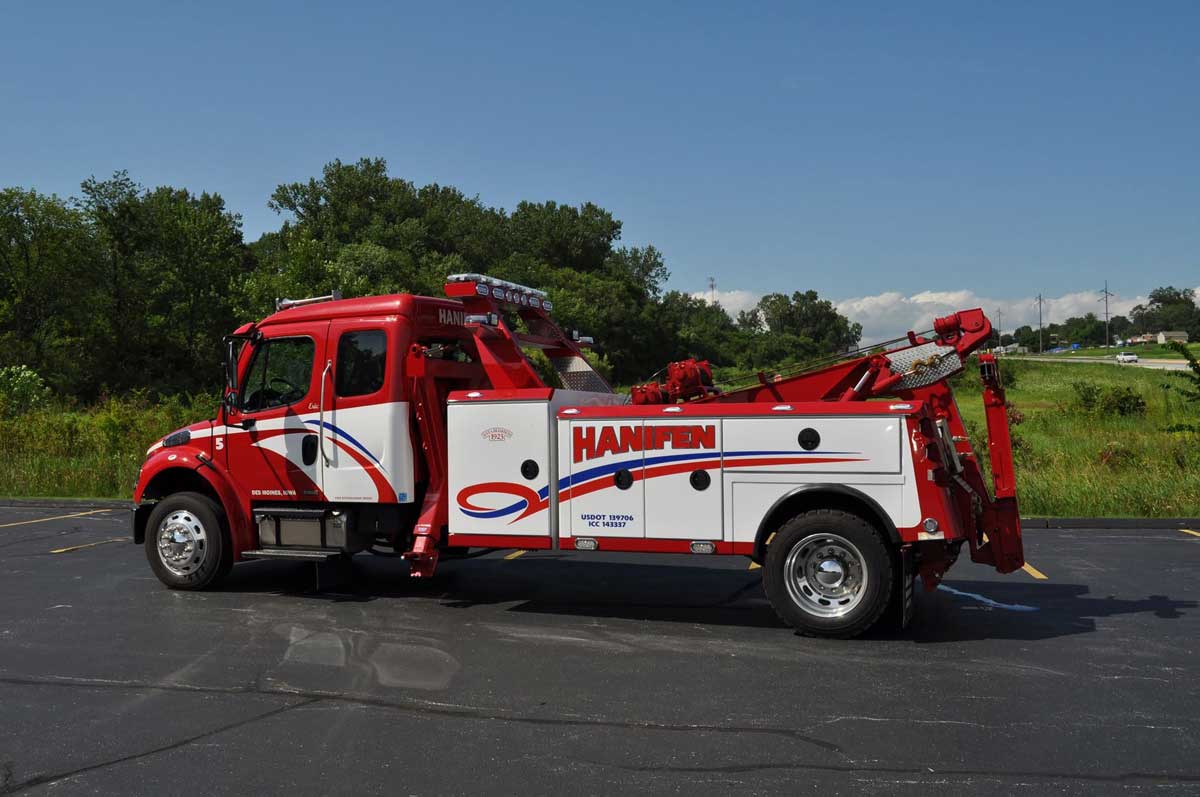
Not much, and we are glad to say so. Hanifen Towing does not do private-property impound at all. Our non-consent work comes through the state, at crash scenes and similar calls. The rest is towing, recovery, and equipment transport somebody asked us for.
Itemized bills. Taking a card. Posted hours. Our name on both sides of the truck. That is how a company that has been in Des Moines since 1923 was already running. If a vehicle does land in our 10-acre yard off I-80, it sits behind a fence and on camera. You can call and find out what it takes to get it out before you drive over. That has been the way we do it for a long time.
Frequently Asked Questions
Does this law apply to a tow I called for myself?
No. Section 321.89 governs abandoned and impounded vehicles. If you asked for the tow, you and the company are in a normal service arrangement, and the notice and reclamation timelines do not enter into it.
My vehicle was towed before July 1, 2026. Which rules apply?
The timelines in effect at the time of that tow are the ones that apply. If you are in the middle of a dispute that straddles the date, that is a question for an attorney or for the police authority handling the impound, not for a blog post.
What if the notice never reached me?
Notice counts as given when it is mailed or delivered, so a letter lost on your end does not stop the clock by itself. If police ordered the tow, or hired the company that did it, you can ask that police authority for an evidentiary hearing to contest the fees or what happens to the vehicle.
How do I find out where my vehicle was taken?
Call the police department for the city where you parked. Since July 1, a company that tows a vehicle off a private lot has to report the tow, the vehicle, and the release location to that department within two hours.
If you need a tow or a recovery in the Des Moines metro right now, call 515-243-3205. We run around the clock. For a commercial account or a scheduled equipment move, start at our contact page. And if you are just deciding now who you would call later, we put together a guide on how to choose a towing company in Des Moines. Save the number. We are here to help.