
An Iowa tow ban means the road is too bad for tow trucks to work, so stranded vehicles stay put until it lifts. On the Iowa 511 map it shows up as a county shaded light blue, labeled Towing Not Recommended. While it is in effect, the only vehicles that get moved are the ones law enforcement calls in because they are blocking traffic or a plow. If you slide off during a ban, stay buckled in your vehicle, call 911, and let officers get you somewhere safe. The car waits. When the ban lifts you arrange the tow, and you should expect a line.
Key Takeaways
- A tow ban pauses ordinary towing in a county until conditions improve.
- Check the light blue counties on Iowa 511 before you leave the house.
- If you go in the ditch, stay in the vehicle and call 911.
- Only vehicles law enforcement calls in as a hazard get moved during the ban.
- When it lifts, every tow company in the area is working the same backlog.
What is an Iowa tow ban?
It is a call that the weather has gotten bad enough that towing and roadside work should stop. The Iowa DOT puts it plainly: conditions are too dangerous to provide towing or roadside services, operators should wait until things improve, and if you are stuck you should find a ride to a safe place. Their guide to Iowa 511 winter road conditions lays it out.
You will hear it called a tow ban on the news and from troopers. On the 511 map the label is Towing Not Recommended. Same thing, different wording.
It is not a road closure. What stops is the work of pulling cars out of ditches and off shoulders, because that work puts a person on the edge of a live lane in the worst visibility of the year.
And it happens more than people think. During one January 2024 storm, 63 of Iowa’s 99 counties had tow bans in place at the height of it. Polk County, along with neighbors like Story and Jasper, has been on that list in past storms.
Who calls a tow ban, and how do you know one is on?
Law enforcement calls them county by county. Usually it is the county sheriff or the Iowa State Patrol, and the ban gets posted to the Iowa DOT’s 511 system. That is why one county can be under a ban while the next one over is not, and why a ban can go up at 8 p.m. and come down at 2 a.m. without you knowing.
The fastest check is the Iowa 511 map. Counties under a ban are shaded light blue. The Iowa 511 app sends alerts for your saved routes, and you can call 511 from anywhere in the state. Local TV and the sheriff’s social media will post it too, if you follow them.
Here is what we tell people: if your county is light blue, stay home. Not because the roads are impossible. Maybe they are fine. But if something goes wrong, nobody is coming for the car until morning or later, and that is a lot of time to sit in a ditch.
What should you do if you slide off during a tow ban?
Most storm slide-offs on I-80 and I-35 look the same. Nobody hurt, car buried to the doors, driver shaken up and unsure what to do next. Here is the order to follow.
- Stay in the vehicle, seat belt on. The Iowa DOT is blunt about this in its advice for drivers who slide off the road. The car is your shelter, and it is the thing rescuers are looking for. Other cars are sliding too. The next one may end up where you are standing.
- Call 911. Give your direction of travel, the nearest mile marker or exit, and whether anyone is hurt. Officers can get you and your passengers a ride to a safe location even when the car has to stay.
- Turn on your hazards. They help plows and other drivers see you, and in a whiteout that matters more than anything else.
- Keep the tailpipe clear. If you run the engine for heat, check that snow is not packed around the exhaust. Crack a window. Run it in short stretches to stretch your fuel.
- Do not try to walk out. Not in a whiteout. Not along an interstate shoulder.
- Do not rock or drive it out. You can bury it deeper, burn up a transmission, or slide back onto the road at the wrong moment.
When you get a ride out, take what you cannot do without. Phone, wallet, house keys, medication. Snap a photo of the nearest mile marker or sign. An exact location saves a lot of time when you call for the tow later.
Why won’t a tow truck just come get you?
Because the work itself is the danger. A winch-out from a snowy ditch means an operator on foot, beside a travel lane, running a cable across the shoulder. It is rarely quick. Visibility is short. Traffic is sliding. A car that loses it at 40 miles an hour has nowhere to go but the shoulder, and that is where the operator is standing.
Iowa’s move over law, Iowa Code section 321.323A, requires drivers to change lanes or slow for a stopped tow truck with its lights on, and for any stopped vehicle with its hazards flashing. In a whiteout, plenty of drivers never see those lights in time. A tow ban takes that risk off the table until the road is safer.
I get it. You are cold and stuck and it feels like someone should just come. But the call is right, and in all my years at Hanifen I have never seen a car worth a driver’s life. Yours or ours. Not one.
What happens to your car while the ban is on?
Usually nothing. It sits where it stopped. You wait for the ban to lift and someone comes for it.
The exception is a vehicle in the way. Under a ban, the only tows that happen are the ones police or the DOT call in for a vehicle blocking traffic or a plow. If that happens to yours, it is a non-consent tow, and you did not pick the company. You still have rights, though. Iowa changed the notice and reclaim rules on July 1, 2026, and we walk through them in what the 2026 Iowa towing law changes mean for drivers. The first step is simple: call the law enforcement agency that worked your slide-off and ask where the vehicle went.
Lock it before you leave it. Do not leave the keys inside unless an officer specifically tells you to.
What happens when the tow ban lifts?
The phones light up. Every car that went in the ditch overnight needs to come out, and every tow company in the county is looking at the same list. Be patient, and be ready. A good call goes faster for everyone.
Have these in hand before you dial:
- Exact location: road, direction, mile marker or nearest exit
- Year, make, model, and whether it is front, rear, or all-wheel drive
- Whether it is just stuck or actually damaged
- Where you want it taken: home, your body shop, the dealer
- Anything unusual: a lowered car, a trailer, a load in the bed
Expect the job to be a recovery, not just a tow. Pulling a car up out of a deep ditch with a winch is a different job from loading one off a flat parking lot, and a good company will tell you that up front when you call. It is not a sales pitch. It is them telling you what they are going to do.
If you have towing coverage through your insurance, call your insurer first so you understand what they will pay for. Our post on paying for a tow out of pocket or through insurance covers the tradeoffs.
One more thing. Know who you called. After a big storm, a tow truck that shows up and offers to hook your car before you have talked to anyone is a reason to slow down. Ask for the company name and how they price the job before anything gets hooked. Our guide on how to choose a towing company in Des Moines is worth a read now, while the roads are still dry.
What about semis and commercial trucks?
A jackknifed semi across two lanes of I-80 is exactly the kind of hazard law enforcement calls in during a ban. Nothing else moves until it does. Those calls need heavy wreckers, sometimes a rotator, on scene in the worst conditions of the night.
If you run trucks through Central Iowa, the time to set up a heavy-duty towing relationship is before the first storm, not on the shoulder during it. We covered what that looks like in our heavy duty towing guide for fleets in Des Moines.
Where Hanifen Towing fits
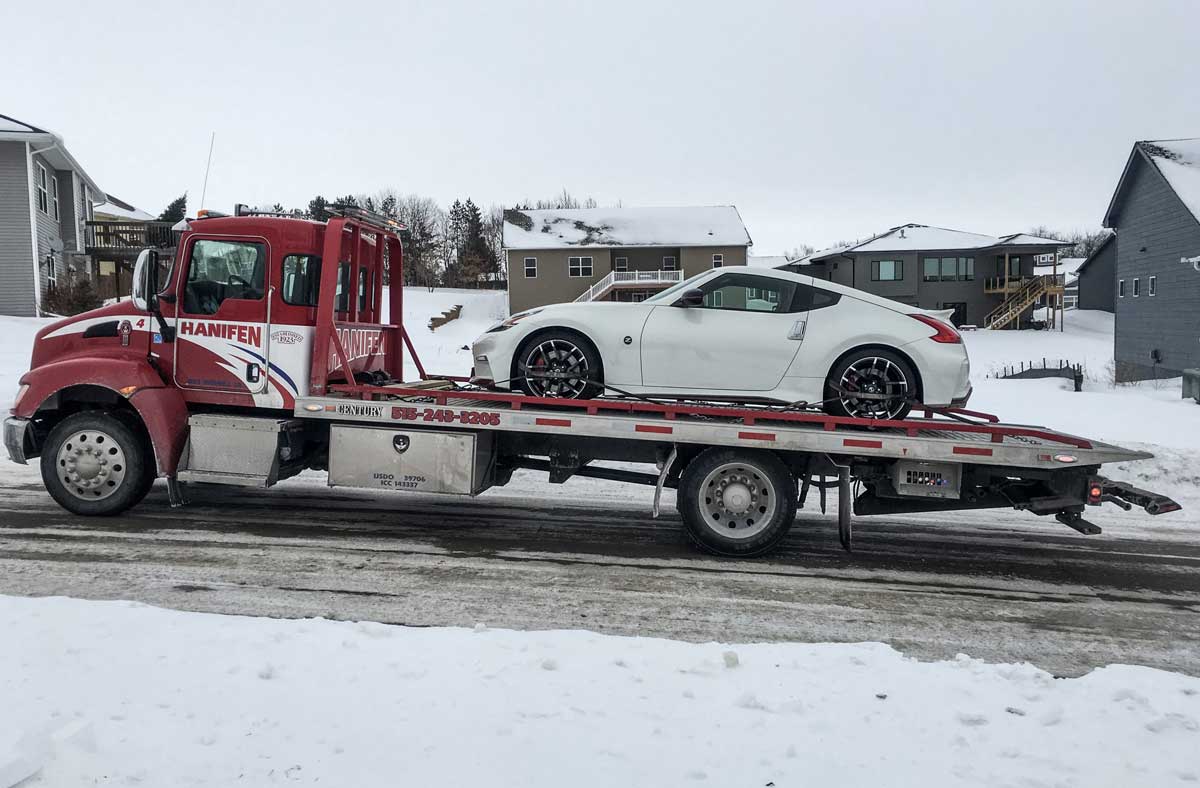
Hanifen has been pulling Des Moines drivers out of Iowa ditches since 1923, and when the road clears we are in the backlog working through it. We run 24/7 out of our yard off I-80. Thirteen flatbeds for cars and pickups, eight heavy-duty wreckers, a 75-ton rotator for the big wrecks. The flatbeds have air bags that lower the bed, so a low car comes up without scraping the undercarriage. Towing a car off a driveway is one job. A winch-out from a snow ditch or a rolled semi at 2 a.m. is another, and that is the work our crews and equipment are built for.
When a ban lifts, we work through the backlog as fast as the roads and the safety of our crew allow. We will tell you straight what your job involves before we hook up. See our light and medium duty towing and vehicle recovery pages for more.
Frequently Asked Questions
Is a tow ban the same as a road closure?
No. A closed road is barricaded and you cannot legally drive it. A road in a tow ban county can still be open to traffic. The ban means stranded vehicles will not be pulled out until conditions improve, unless law enforcement calls one in as a hazard.
Can I pay a tow company extra to come during a ban?
A reputable company will say no and put you on the list for when it lifts. If someone is willing to work a shoulder in conditions law enforcement has called too dangerous, ask yourself how carefully they are going to treat your car.
Do I need to call 911 if I slide off and nobody is hurt?
During a storm, yes. Law enforcement wants to know where stranded drivers are, and they can get you to a safe place even when the car stays put. It also puts your location on record if your vehicle later has to be moved as a hazard.
How long do tow bans usually last?
Anywhere from a few hours to a day or more. It depends on how long the snow, wind, and visibility stay bad. Watch the 511 map. When your county loses the light blue shading, the ban is off.
Stuck after a storm in the Des Moines metro? Call 515-243-3205, day or night, and save the number before the first snow. For a fleet account or a scheduled job, start at our contact page. We are here to help.